Thursday, February 6, 2014

A Cityscape in the Round: TJ Wilcox: In the Air, at the Whitney Museum.

A View of TJ Wilcox's Cinematic Panorama at the Whitney.

I'm a lifelong New Yorker and an artist who often draws on the city for inspiration and subject matter.  So,  I've long been aware of how much Manhattan has changed over the decades, and yet how much it seems to stay the same; of how much history attaches to the place too, both personal and public---- phenomena that the TJ Wilcox's installation at the Whitney, "In the Air," mimics.  In recent years I've been painting more ambitious cityscapes than the little plein air ones I've long done, so I find myself grappling more and more with what I want them to convey:   Do I want to make a realist statement about the insignificance of the individual in a place as vast as New York?  A magic realist one about the often random aspect of life in a place as large and varied as this?  Perhaps a little of both, as contradictory as that may be.  So, it was with great curiosity that I visited the Wilcox show and made note of his take on the city.  And, Wilcox's panorama of Manhattan is nothing if not contradictory, showing both the exuberant creativity of New York artists and the destruction that has been visited upon the city, too.

I always enjoy viewing other artists' portrayals of New York precisely to see their take on it.  And I wasn't disappointed by this show.  The installation is quite large, it takes up most of the Museums's second floor and consists of a giant circular screen, upon which a kaleidoscopic panorama unfolds:  According to the installation wall text, the cinema-in-the-round format harks back to the late nineteenth century, when cinema was a new medium.  Wilcox's panorama is a 360-degree view of Manhattan, using four cameras, it was shot from the rooftop of Wilcox's Union Square studio on a single day in September 2012----from sunrise to sunset.   Using some sort of stop-motion animation technique, Wilcox was able to greatly speed up the fifteen hours between dawn and dusk to fit a half hour long format; that serves as a backdrop or framing device for six short narrative films that are shown sequentially.
A still from "Futura," one of six film vignettes that appear
within "In the Air." 

The narratives range from the distant past to more recent events.  Taken together, they form, as much as anything, a meditation on the interconnectedness of past and present, both imagined and real; and of the intersection of personal memory and the historical record.  There is no real logical progression from one vignette to another.  Yet there is just enough thematic similarity between some of the narrative films to make them seem to tie into one another:  The vignettes "Futura" and "John,"  are an example, each relates a large-scale catastrophe that left an indelible mark on the public.  The former, the crash of the Hindenburg; the latter, the terrorist attack on the World Trade Center.  Obviously, there is no rational connection between the two events, the only tie-in, the theme of catastrophe and collective trauma. Similarities that are arbitrary, without any factual relation.  Yet, in the viewing of "In the Air," random similarities seem to take on the aura of significance.

 "Futura" uses old news footage showing the Hindenburg crash interspersed with Wilcox's filmed mock-up of an apparently actual, unrealized, plan to use the Empire State Building as a docking station for dirigibles.  I must say, I thought the mock-up was one of the panorama's more amusing touches.  In it, people are shown on a very flimsy looking gangway extending from a blimp to the top of the Empire State.  It added a note of levity to an otherwise tragic subject.

"John" uses the superintendent of Wilcox's building to relate the attacks on the Trade Center.  By using his superintendent's eye-witness account, instead of news footage, Wilcox establishes the interconnectedness of personal memory with that of the public account.  Of course, Wilcox didn't have to show us images for us to visualize what happened that day.  We saw the attacks televised, over and over.   But the super's matter-of-fact narrative makes the events more relatable, seem less mythic, more down-to-earth:  He describes going from incredulity, to horrified realization----not unlike the reaction I had to telecasts of the attack!
"Silver Cloud," one of six vignettes that unfolds during the
cinematic panorama:  "In the Air."

I was also amused by the vignette "Silver Cloud." It shows footage shot from Andy Warhol's 47th street "factory" rooftop in 1965, interspersed with newscasts of the papal visit of Paul VI.  In the film a helium filled silver phallus is being launched aloft while the pope's motorcade passes below.  It's a little hard to believe that the film's narrative arc is entirely authentic.  I'm guessing that the launch was shot separately, then added to news footage of the papal visit.  But the conceit of the pope receiving a phallic salute on his visit to the city is very funny.  Like "Silver Cloud,"most of the short narrative films are collages, mixing footage from several sources, such as old news reels and recreations or re-imaginings of events.  And, it isn't always clear what's what, blurring the distinction between fact and fiction.

"Manhattanhenge" is the last of the six vignettes.  It shows the biannual phenomena of the same name.  As natives such as myself probably know, Manhattanhenge is a phenomena that occurs every spring and summer:  On the equinox the setting sun aligns with the basic street grid in Manhattan, so that the sinking disc is visible on the major cross streets, at least those with an unobstructed view such as 57th and 42nd streets.  As you may already know, Manhattanhenge is a neologism derived from Stonehenge.  So, the closing vignette creates an allusive association between Manhattan and a bi-gone and mysterious people.  I suppose the suggestion is that one day the sun will set permanently on Manhattan as it did on the civilization that created Stonehenge.

I regret not having seen "In the Air" before.  It is an enormously original vision of New York:  past and present; factual and not.  Yet "In the Air" seems so authoritative and all-encompassing that it seems like much more; almost like a definitive portrait of the city.


TJ Wilcox:  In the Air ends February 9.  Whitney Museum, 945 Madison Avenue (at 75th St.), NYC.


Thursday, January 16, 2014

An Exhibition Of Dutch Genre Paintings On Loan From The Mauritshuis.

Jacob van Ruisdael, View of Haarlem with Bleaching Grounds, c. 1670 - 75.

I recently went to the Frick's exhibition of Dutch Golden Age paintings, on loan from the Mauritshuis. It is small, only fifteen paintings, but absolutely fabulous----really gorgeous!  Unfortunately it closes in a couple of days, so you'll have to run if you want to catch it!  The Frick has given Vermeer's Girl with a Pearl Earring (1665) the place of honor in the show, making it clear that it is meant to be the star attraction.  But while it is undeniably beautiful, I don't think it is the most interesting aspect of the exhibition.   Rather, I think the show in its entirety provides a compelling, insightful and fun look at the seventeenth century Dutch mindset.  It offers a representative sampling of Dutch genre painting.  The subject matter includes still lifes, landscapes, domestic scenes and portraits that, by and large, depict the everyday life of ordinary middle class folk, in marked contrast to much of what was being produced elsewhere in Europe at the time.  It is the seeming ordinariness of the images that makes Dutch art of this period seem so relatable:  That is its special appeal!
Gerard ter Borch, Woman Writing a Letter,
c. 1655.

The seventeenth century was the era of Baroque painting in Europe; while it is largely identified with Catholicism and a Counter-Reformation movement, some of the characteristics that typified Baroque art, such as exaggerated contrasts of light and shadow and saturated color, are present in the works of artists such as  Rembrandt, Hals and Vermeer----all represented in this show.  But supernatural, mythological elements that typified much Baroque art are markedly absent from the Dutch Golden Age.  The main reason being that Dutch Calvinism did not allow religious art in churches.  As a consequence, the Dutch artists by and large eschewed religious subject matter in favor of landscapes, still lifes, domestic scenes and other things drawn from everyday, secular experience.  (There are two exceptions represented here, Simeon's Song of Praise and Susanna, both painted by Rembrandt----one of the few Dutch artists of the era to paint biblical scenes.)  Ruisdael's landscape (shown above) is representative of the secular strain:  The workers in his fields are barely visible, they have been reduced to mere specks; there are no larger-than-life entities astride his land, no angels in his skies.  While the clouds that dominate his landscapes may be more evocative than scientifically accurate, they are, nevertheless, just natural formations devoid of supernatural elements.  His is a vision shared by such seventeenth century thinkers as Newton:  In the newly discovered infiniteness of the universe, humans have been reduced to insignificance.

When I think of Dutch seventeenth century painting, what comes to mind foremost are detailed scenes of domestic life----the sort Vermeer is famous for.  Unfortunately, the only Vermeer included in the show is the portrait, Girl with a Pearl Earring.  However,  several Vermeer's from the Frick's permanent collection, which I think are more representative of his oeuvre and Dutch genre painting in general, are on display elsewhere in the museum.
Jan Steen, As the Old Sing, So Pipe the Young, c. 1665.

In this show the domestic scenes are by Gerard ter Borch (Woman Writing a Letter, above), Jan Steen (Girl Eating Oysters, c. 1658, and As the Old Sing, So Pipe the Young, left) and Nicholas Maes, (The Old Lacemaker, c. 1655).  These genre painters depicted scenes of everyday life and ordinary people with a detailed realism representative of traditions passed down from earlier Netherlandish painters such as Pieter Bruegel.  And, apparently, they shared the earlier artists' love of proverbs too!  Indeed a certain Calvinist puritanism seems to have been common in the Dutch Golden Age.  While Jan Steen's paintings appear at first blush to be more or less straightforward depictions of daily life, they are thought not to show real people. Instead, they are thought to be populated with stock characters such as one would find in a theatre troupe (apparently, Steen had an uncle who belonged to such).  Steen's scenes are arranged in a stagey manner to deliver the pictorial equivalent of declamations against bad behavior.  But, while his paintings are moralistic, the admonitions are leavened with humor; in fact his paintings are rather fun.  Colorful, and even chaotic,  they  portray various manner of bad behavior with only subtle hints to suggest a moral.  Everyone in Steen's As the Old Sing, So Pipe the Young looks to be having quite the jolly old time.  It is ostensibly a family celebration, but the proverbial warning of the title appears on the pages the old woman holds, alerting the viewer that this is a lesson!  More subtly, a parrot and a pipe are meant to suggest symbolically that adults' bad example is imitated by their young.  The use of symbols to convey moralistic or proverbial messages seems to have been popular with the seventeenth century Dutch; they appear in other works in the show as well.
Pieter Claesz, Vanitas Still Life, 1630.

Domestic scenes weren't the only venues for Dutch moralizing, as Pieter Claesz's still life, Vanitas (1630) makes clear.  The painting is meant as an allegory.  Vanitas is Latin for vanity, and vanitas images are meant as admonishments against attachment to material goods.  The human skull is a reminder of mortality and the time piece, overturned goblet and frayed folios show the impermanence and, therefore, worthlessness of earthly goods.  I know, the painting may sound unbearably grim, but everything is so beautifully done, that the painting seems to embrace the very attachments it is warning against!

While it was apparently important to Dutch artists of the era, to provide moral instruction, they manage to delight the senses as well.  Indeed, the images are so beautifully realized that it is easy enough to miss  the sermon. And, while this show is small, it manages to give a concise synopsis of what the Dutch Golden Age is all about, making for an educational as well as fun view!


Unfortunately, the show ends this Sunday, January 19th.  The Frick is located, 1 East 70th Street, New York, NY  10021.


Wednesday, January 1, 2014

The Magritte Exhibition At MoMA.

The False Mirror, 1929.


Wow!  "The Mystery of the Ordinary," the Magritte show at the Museum of Modern Art, is really something else!  I was blown away!  The exhibition is huge, featuring some eighty paintings, collages and other items.  And, the focus is on the major ideas and themes that animated Magritte's surrealism such as:  Displacement and isolation; the inadequacy of language to accurately represent things; the opposition between perceptions of what is rational and individual psychological experience; and the difference between the illusionism of traditional painting and physical reality. The show deals with the period between 1926 and 1938, when he produced his most important and memorable surrealist works.  I left the exhibition with a new appreciation for Magritte.  I think it's easy to view his art as gimmicky however, given the picture puzzle aspect of much of it; but that is way too facile; although, many of the visual games he plays have a certain adolescent appeal.  (If you saw his paintings when you were a teen, you might remember thinking:  "How cool!"  Or something along those lines.)
The Treachery of Images, 1929.

As this show makes plain, Magritte was more interested in ideas----in making a statement----than in making attractive or decorative paintings.  He wanted his art to challenge conventional perceptions, to make the viewer reconsider their perception of what is rational.  And, while surrealism was very much a product of 1920's-30's Europe, Magritte's art still seems pertinent.  Today television and the internet can make the distinction between reality or not seem rather amorphous at times.  Also, the sense of disquiet and dread that many of his paintings convey still seem to resonate, although the underlying causes are different then they were in pre-war Europe, of course.  Today it is rapidly changing technology, as well as economic instability, that create a sense of unease and uncertainty.  Art movements of a more recent vintage such as pop and conceptual art show the influence of Surrealism; but hey, maybe it's time for a neo-surrealist movement!
The Secret Player, 1027.


Surrealism challenged rationalism and social constraints.  And, Magritte posed that challenge through the illogic of his images:  Objects appear decontextualized, or dream-like, people have inexplicable doubles.  Many of his paintings feature a curtain on each side, as if drawn back for a big reveal of sorts. The effect is----contradictorily----to suggest that a hidden truth is being exposed or that the composition is a conjuror's illusion.  In "The Secret Player" he uses such a device, there a curtain has been pulled back to expose a scene that defies explanation; it has all the logic of a waking dream.  A man and a double of the man play some undefined game in a make-believe forrest of balusters, while a woman in a corset wearing a surgical mask appears from behind a cabinet door.  What does it all mean?  Who knows?  And, although there is nothing particularly dynamic about the way Magritte painted "The Secret Player," The mysteriousness of the scene is undeniably intriguing.

Surrealism had its antecedents in the nineteenth century Romantic and Symbolist movements.  It not only shared an opposition to rationalism with those movements, but like the earlier artists, the surrealists conceived of, and presented reality as basically a mental projection; however, the individual, as conceived by Magritte, seem to have considerably less control over his/her life.  Magritte presents individuals as largely spectators to the drama of life, rather than as primary actors.  He conveys that through recurring motifs, such as:   doppelganger-like doubles;  dream-like imagery; and the use of stage-like curtains pulled back to bracket his compositions.
Not to be Reproduced, 1937.

Some of his double images convey a sort of out-of-body experience, too.  As if the individual is watching their own life unfold at a remove.  That is the sense I get, anyway, from "Not to be Reproduced," Magritte's "portrait" of art collector Edward James.  I love this painting!  Because of the literal manner in which details are painted, it takes a moment to realize that the imagery makes no sense.  That the secondary figure is not a mirror reflection of the foreground figure, but a slightly diminutive double.  And, yet the secondary book cover is indeed a mirror reflection of the one in the foreground.  So, what is happening here?  As with "The Secret Player" and other Magritte's, "Not to be Reproduced" defies rational explanation.  But one thing that is certain is that the universe represented here does not conform to the laws of physics, or logic!

There are a number of Magritte's word paintings in the show too.  Including, what is probably his most famous one:  "The Treachery of Images," which has the image of a pipe with "Ceci n'est pas une pipe" (this is not a pipe) written beneath.  As many have already observed, Magritte is making the point that a painted representation of something is not the thing itself.  "The Treachery of Images" deals with the dichotomy between reality and pictorial representation----between reality and illusionism.   However, most of his word paintings are even more concerned with the difference between linguistic representations and their real life objects.  "The Interpretation of Dreams," 1936 is more typical of his word paintings.   In it, four objects are pictured with written captions, but the words and images don't match.  I suppose the point is that words aren't adequate substitutes for real things any more than visual images are.  I have to admit I'm not a big fan of text in paintings, in Magritte's or anyone else's either.  I think a painting should make its statement visually.  Relying on text to get a message across always seems like a copout to me.
The Threshold of Liberty, 1936.

The show includes some of Magritte's collages, which are of interest only because many of his paintings, such as "The Threshold of Liberty," have a collage-like sensibility.  It looks as if collage may have been the original inspiration for some of his recurring themes such as isolation, displacement and decontextualization.  In "The Threshold," and other paintings, Magritte juxtaposes unrelated images to create an imaginary interior space:  A female torso is adjacent to wood paneling, which is adjacent to jingle bells, which are next to marble paneling, which is on top of lattice work, and so on.  The seeming randomness of the selection of images has a mimetic aspect.  It suggests a process of mental association, in which the connection between things isn't always rational----or obvious.  And, seeing Magritte's collages in the show, was a bit like peeking behind the curtains at his thought process!  Indeed, the comprehensiveness of the show made it possible to gain insight into the development and expansion of all the themes that play a salient part in Magritte's oeuvre.

The Magritte exhibition at the Museum of Modern Art is exhilarating and inspirational!  Many of the works on display grapple with ideas about art that concern artists of all eras:  In particular the difference between illusionism and reality----between the two-dimensionality of a canvas and perspectival illusion.  But, while Magritte's paintings certainly transcend their time, I don't think they could have been produced in any other period or place than 1920's-30's Europe.  His surrealism betrays the widespread interest and cultural influence Freudian psychology had during the era; although, Magritte insisted that his paintings weren't open to psychological interpretation.


The Magritte show is at the Museum of Modern Art until January 12.  11 West 53rd Street, New York, NY  10019. 

Tuesday, December 3, 2013

I'm Back!

Late Summer Fugue, 2013, 12"x16," watercolor on paper.   All
copyrights reserved to the artist.  (c) 2013.
I hope no one has given up on my blog.  I know I've been remiss in not posting anything for awhile, but I intend to begin doing so on a regular basis again.  My hiatus was due in part to the unusually mild weather this fall.  I couldn't resist the opportunity to continue doing the plein air painting I began in the summer.  There is something really special about the experience of painting in situ, a sort of sense of discovery.  You gain a heightened awareness of all aspects of a particular place:  Its physical dimensions; how it looks in different light conditions; you observe who uses the space and how.  But now that the weather has turned cold I intend to start going to museum and gallery exhibitions once again.  I'm already really excited about some of this winter's shows!  In particular, the "Masterpieces of Dutch Painting" at the Frick and the Magritte show at the Modern.  I only hope you will once again tune in to read my posts!  In the meantime, here is a sampling of my plein air work from this summer and fall:
Central Park Footbridge in Autumn, 2013, 14"x20," watercolor on paper.
(c) 2013.
Central Park Footbridge, Overcast Afternoon, 2013, 10"x14," watercolor on paper.
(c) 2013.

These three are all the same bridge in Central Park.  I was drawn to its shape; there is something compelling about the tension created by the repetitiveness of the multiple arcs.  They form a visual vortex that pulls the eye in and directs it to the view beyond.  It is also fun to observe how differing times of year and weather altered everything.

In addition to doing multiple takes on a footbridge, I did a series of city park fountains.  In the process I became much more familiar with many of the city's parks than I had been before.  The ones below are, respectively, on the lower east side of Manhattan and just east of Chelsea.
  
Stuyvesant Square Park Fountain, 2013, 14"x10,"
watercolor.  (c) 2013.
Madison Square Garden Park, 2013, 10"x14," watercolor.  (c) 2013. 

I also painted some street views.  Below, a scene on the lower west side of NYC:
Staple Street, 2013, 14"x10," watercolor.
(c) 2013.
Staple Street is a wonderfully quiet oasis in a spectacularly noisy city.  It is a teeny side street, just off of Duane, which is pretty quiet to begin with.  The paintings I did there were probably the most successful street views I did this summer or fall, which I attribute to the tranquility of the place.  All the other ones I tried were in the midst of a fair amount of traffic, both foot and vehicular.  While I credit myself with superior powers of concentration, I nevertheless found it too distracting to achieve anything worthwhile.

 Also, fun was to paint sites that I'd done in the past, and then compare the results.  Below, two takes on the Bethesda fountain in Central Park----done two years apart:        
Balustrade & Bethesda Fountain, 2013,
10"x10," watercolor.  (c) 2013.
Balustrade & Bethesda Fountain, 2011, 9"x12," watercolor.
(c) 2011.


By the by, The newer version is in the "Small Works Exhibition" from December 4 - January 12 at the Manhattan Borough President's office, 1 Centre Street, 19th Floor, NYC  10007.  And, the older version will be on sale ($200.00) in the Art Students League's annual holiday exhibition, which runs from December 6 to the 22nd.  Art Students League, 215 West 57th Street, NYC  10019.

Monday, September 16, 2013

Light And Perception: James Turrell's Light Installations At The Guggenheim.

A rendering of James Turrell's Aten Reign installation at the Guggenheim.
For an unique experience, try to see the James Turrell exhibition at the Gugggenheim before it closes (September 25).  Usually, I'm not a big fan of light sculpture, but I was bowled over by this show.  But then, what Turrell does isn't really sculpture----at least not in the conventional sense.  Rather his installations are immersive and transformative experiences that challenge the viewers notions of perception; particularly in terms of perspective and tangibility:  In some of his installations he makes light itself appear to be a solid object by using apertures to project it in relative darkness.  Turrell has a degree in perceptual psychology and his installations seem as much sensory experiments as works of art.  They make the viewer aware that what they think they see isn't necessarily so.  His artwork calls to mind Plato's Allegory of the Cave, in which cave dwellers' perceived reality is merely shadows on a wall.  And, after having been immersed in this exhibition it's hard not to wonder about one's own grip on reality----is what one sees actual, or just shadowy illusion?

Prado, 1967.  In this installation light
is projected through an aperture onto
an otherwise unlit wall.
Turrell was in the forefront of the light and space movement that began during the sixties in California. One suspects that his interest in perceptual phenomena may have been influenced by the aesthetics of the era's psychedelic drug culture as well; even if he didn't use hallucinogenics himself----there is something decidedly trippy about his work; although, the exhibition catalog cites only his Quaker upbringing and background in perceptual psychology as determining influences:  Turrell has said that he wanted to recreate the meditative and participatory environment of Quaker prayer meetings in his installations.  I didn't find Turrell's installations to be particularly conducive to meditation, but they certainly are participatory:  They are more than just lights, they are also manufactured environments that encompass the viewer, forcing one's senses to become fully engaged.  As Turrell has said, his installations are as much about the act of perceiving as they are about what is perceived.  Particularly since what that is, isn't always so clear.

If you go to the Guggenheim, the first installation you'll come upon is Aten Reign.  The museum's rotunda has been transformed by it:  The usual open, airy architecture replaced by a series of concentric cones that both make the space smaller and saturate the viewer in an intense color that slowly moves across a full spectrum, ranging from red to blue, and back again.  The piece has been described as a skyscape.  I suppose it is, but not like any I've ever seen.  The intense color seems too alien, extraterrestrial even:  I imagine it is what the atmosphere might be like on a planet much closer to its sun, than ours is to ours.
A view of the site specific installation:
Aten Reign.


Aten Reign is also about sensory deprivation though.  While the light changes color, it is of an uniform intensity that numbs the senses, making it hard to fully understand the area's physical dimensions.  (The sensation was disorienting.)  As an undergrad, Turrell studied something called the "Ganzfeld effect."  It is a perceptual phenomena resulting from uniform and unstructured stimulation; as much about loss of vision as it is about seeing.  Aten Reign's successive colors also create distinct after images, adding to the sensory confusion.  Iltar is another installation that uses sensory deprivation.  It consists of a dark, indistinct room with what looks like a dark rectangular screen illuminated by the faintest of light projected onto the two opposite walls.  One optical effect is that the lights start to seem as if they are pulsating; another, the rectangle seems to grow darker.

I have to admit, I was a touch disappointed with Iltar.  There was quite a wait before I could see it.  The installation setting consists of a small room, and only two or three viewers are allowed in at a time.  One result was heightened expectations that weren't quite met.  Still, it was an interesting experience.  My favorite installations though are Afrum and Prado both 1967, and Ronin 1968.

Afrum, 1967.  This is a cross-corner
projection.
Turrell has said that he wants to treat light as material, not just as a source of illumination.  And his piece Afrum succeeds sensationally at that.  It is a cross-corner projection, consisting of two apertures each beaming light onto an adjoining wall.  If you see it, you'll think at first that it is a three-dimensional object suspended in a corner.  Although, it also seems to change shape as the viewer moves around the room; it seemingly shifts from cube to rectangle to trapezoidal shape.  Only by walking up to the corner, does it becomes apparent that there is nothing solid there; instead, only light projected onto the walls.  Unlike Afrum, Prado and Ronin each consist of only one aperture from which light is beamed.  But, like Afrum, Prado and Ronin appear tangible, like something tactile.  Ronin appears as a separate plane, slightly apart, seemingly angled away from the wall plane upon which it is projected.  Whereas, Prado looks like a light filled doorway, you almost think you could walk through it.  It is only up close that the illusions becomes apparent.

Ronin, 1968.
I can't emphasize enough how special this show is; or the extent to which it changed how I think of both light and sensory perception.  It made me more aware that light can be experienced as not only a source of illumination for physical objects, that it can transform itself into an apparent thing in its own right.  Or, transform an environment into something quite alien----and otherworldly.  And, if I didn't often question the veracity of my senses prior to this show, I will now!

Guggenheim Museum, 1071 Fifth Avenue (@89th Street), NYC.  Unfortunately the show ends on the 25th of September.


Friday, August 16, 2013

Civil War and American Art At The Metropolitan Museum.

Frederic Edwin Church, Cotopaxi, 1862.
I recently went to the Met's Civil War exhibition.  While there are many figure and genre paintings, the emphasis is on landscape, which I suppose isn't surprising given the popularity of landscape painting during the first half of the nineteenth century.  (As a landscape painter myself, I always take a special interest in seeing how the subject matter has been handled through the ages.)  What is surprising though is the inclusion of many
Sanford Robinson Gifford, A Coming Storm, 1863.
landscapes with no apparent relevance to the war.  But, it is the controversial thesis of this exhibition catalog (written by Eleanor Jones Harvey)* that they should be interpreted as allegories for the political and social strife of those years; and, therefore, be considered as much about it as the paintings depicting the battlefront.  That is a thesis that I don't entirely buy----with the sole exception of Frederic Church's "Our Banner in the Sky," I think it's too big a stretch.  Although, the political and social strife surrounding the war certainly did influence the general outlook of painters such as Church, as can be seen in his foreboding and portentous landscapes of the era.  Church's "Cotopaxi," 1862 is an example.  A dramatic rendering of the violent and destructive side of nature:  It depicts an Ecuadorian volcano erupting.  Still, I don't buy the notion that these paintings should be interpreted as allegories for the war.  Note that landscape painters had portrayed nature at its most violent long before, and continued to do so long after.
John Frederick Kensett, Paradise Rocks, Newport, 1868.

In addition to Church,  the works of Albert Bierstadt, Sanford Gifford and John Frederick Kensett are on exhibit.  All were part of an American nineteenth century art movement known as the Hudson River school.  The country's dominant movement of the time, the Hudson River school promulgated a highly idealized take on the American wilderness.  During the first half of the nineteenth century its adherents created a transcendental vision of the wilderness, which conceptually, approximated the philosophies of such contemporaneous thinkers as Ralph Waldo Emerson; who held that God could be intuitively experienced through a meditation on nature.  The Hudson River school artists imputed spiritual and regenerative influences to the wilderness too.  The eighteenth century notion of nature as background to a larger, human drama, gave way to paintings in which the landscape took center stage.  Nineteenth century painters tended toward the  animistic in their view of nature; their landscapes are emotive and heavy on atmospherics:  The Hudson River school painters meant theirs to be nothing short of transcendental visions.**    Favorite subjects were mountains, symbolizing a heavenward ascent, and luminous golden light, symbolizing Divine Grace.  (As someone who was a philosophy major, I've always taken an interest in the ideas----particularly metaphysical ideas----that inform art movements and find expression in their adherents' paintings.)


Sanford Gifford, The Camp of the Seventh Regiment near
Frederick, Maryland,1863.
Most of the artists who recorded the war, were primarily landscape painters by training and inclination, and they brought that sensibility with them.  As can be seen in such works as Sanford Gifford's The Camp of the Seventh Regiment near Frederick, Maryland, 1863 and Albert Bierstadt's Guerrilla Warfare, Civil War, 1862.  Both are basically landscape paintings that happen to include the figures of soldiers in them.  There may be an army encampment in Gifford's painting, for example, but the emphasis is on
Albert Bierstadt, Guerilla Warfare, 1862.
the panorama of field, distant hills and the sun breaking through clouds.   Not on the human drama.  Also, notably absent are any scenes of actual combat.  The closest thing are depictions of soldiers aiming rifles, as seen in Albert Bierstadt's Guerilla Warfare.  Since many of the paintings were done on site or from studies that had been, there were logistical reasons for not depicting pitched battle, of course.  But still, one might have expected more of an emphasis on the human conflict.

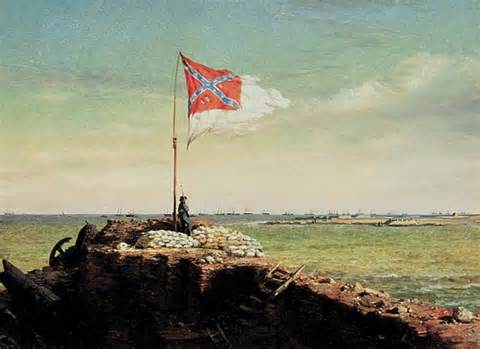
Conrad Wise Chapman, The Flag of Fort Sumter, Oct. 20 1863.
The Confederate side is represented by a sole artist in the exhibition:  Conrad Wise Chapman.  According to the show catalog, part of an ex-patriot family living in Rome, Chapman enlisted with the Confederate army.  After being wounded, he was commissioned to do a series of paintings depicting the fortifications surrounding Charleston's harbor.  Like  Gifford (who was enlisted on the Union side), Chapman is more landscape, than history or genre painter.  His portrayals of Fort Sumter, for example, rely as much as anything on the changing light conditions to convey emotion.  As in Gifford's and Bierstadt's war paintings, his human figures seem almost incidental to their surroundings.  All of which isn't to say that his and Gifford's paintings aren't moving testaments, they are.  Indeed, I wish I could paint such expressive skies!  Although, I have no interest in adopting a romantic aesthetic.  (I am a realist painter and I'm not about to change my basic philosophical bent!)

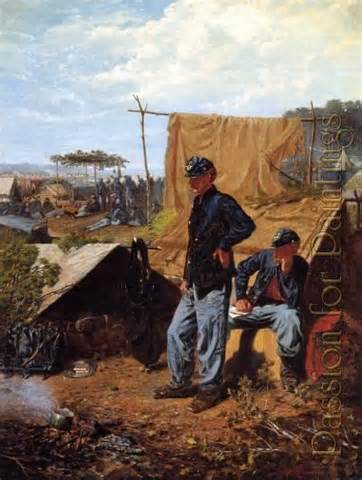
Winslow Homer, Home, Sweet Home, 1863.
Of course the war had a profound and broad influence on artists of the time---no one would argue against that!  And, therefore, as is noted in the accompanying wall text, the exhibition is as much a record of its cultural impact on artists of the time as it is a record of actual events.  And the personal impact on artists can be seen in direct proportion to how much exposure each had (or didn't have) to the battlefront.  Of the landscape painters on exhibit, only Chapman and Gifford were actually enlisted.  And only Chapman had any exposure to battle.  In contrast, Winslow Homer----one of the few non-landscape painters in the show----saw the war up close for prolonged periods while embedded with Union troops at the front.  He did so in the capacity of artist/correspondent for Harper's Weekly.  And unlike the landscape painters, Homer's focus was squarely on the human drama.  Although, like the landscape painters he did not portray actual combat:  The closest he came was 'Skirmish in the Wilderness," 1864, which like Bierstadt's "Guerilla Warfare," shows Union soldiers pointing rifles at an unseen enemy.  But unlike the landscape painters, Homer's scenes of soldiers in camp actually focus on the human drama, showing the personal toll of war.   "Home, Sweet Home," for example, shows two soldiers whose postures and sidewise gazes give them a war weary and preoccupied air.  One has a letter, presumably from home.

Winslow Homer, A Visit from the Old Mistress, 1876.
Also, as can be seen in some of his paintings dealing with the aftermath of the war, Homer clearly took a genuine interest in the political and social issues in the aftermath of the conflict----something that Gifford, Bierstadt and the other landscape artists didn't----or at least not in their paintings!  Homer's "A Visit From the Old Mistress," for example, suggests the difficult social relations that lay ahead for blacks and whites.  It shows newly emancipated slaves being confronted by their former mistress, who must now bargain for their labor.  The tension between them is palpable.  Homer isn't the only genre
Eastman Johnson, Negro Life at the South, 1859.
painter in the exhibition.  Also of notable interest are works by Eastman Johnson.  Like Homer, Johnson took an interest in social issues such as race relations in the South.  His "Negro Life at the South, 1859 is one of the more interesting, if ambiguous paintings on exhibit.  It depicts slaves of varying skin colors in their quarters, next to the master's house.  While there is some ambiguity about the scene, that some slaves were sexually imposed upon by the master is pretty clear.

One of the things I found most fascinating about the exhibition was the disparity between what was being produced by the landscape painters on view, all of whom share a basic romantic aesthetic vision, and their realist counterparts----most notably Winslow Homer and Eastman Johnson.  It is hard not to conclude that the transcendental beliefs of the Hudson River school were ill suited to the portrayal of a manmade catastrophe such as the Civil War; or to addressing the difficult social issues in its wake.  So it isn't surprising that their paintings fell out of favor over the next two decades.

Notes:
*Exhibition Catalog:  Civil War and American Art by Eleanor Jones Harvey.  Smithsonian American Art Museum in association with Yale University Press.  (You can peruse copies of the catalog at the exhibition, as I did.)

**Knights of the Bush:  The Hudson River School and the Moral Landscape.  James F. Cooper.  Copyright 1999, the Newton Cropsey Foundation.  Published by Hudson Hills Press, Inc.

The Civil War and American Art runs through September 2, 2013.  Metropolitan Museum of Art, 1000 Fifth Avenue, NYC.


Wednesday, July 3, 2013

I'm Having My First Ever Solo Exhibition! And Everyone Is Invited!

As I mentioned in my maiden post, one of my purposes in keeping a blog is to record my progress transitioning from amateur artist to professional.  Later this month I achieve a major milestone with the opening of my first solo exhibition to date.  (I have participated in many group shows in the past, but this is a first!)  I will have eight watercolors on view from July 15 to August 10 at Berlitz Language Center, located at Rockefeller Center.  (Rockefeller Center!  Cool huh?)  While Berlitz may not be an actual art gallery, it is a great location; and it is open to the public; and everything in the show will be for sale too!  Eventually (like every artist) I hope to have gallery representation, but it is my understanding that galleries won't take you seriously unless you've had at least some solo shows already.  I have planned everything out quite thoroughly, so I don't expect any glitches; nevertheless, this will probably prove a useful learning experience.  (Hopefully, not too much of one, though.)

My exhibition has a theme, it is fresh produce.  Hence the show's title, Fresh Produce:  Eight Still Lifes (See the invitation, below).  I think it is useful, as an organizing principle, to have a  theme.  It gives a show added interest and more cohesion than it would otherwise have.  Additionally, it is my understanding that classes at the Berlitz Language Center make use of any art exhibited there to practice  conversational skills.  (A notion that I find quite amusing!)  And, I think a thematic art show might lend itself more easily to discussion.


       __________________________________________________________________________


My primary intention in focusing on perishable fruits and vegetables is to emphasize the temporal, though.  No matter what state I capture the produce in, it is only a phase:  A moment in time!  I think the short life cycle of produce, in all its manifestations, makes it the best metaphor for life's ephemeral, transitional nature.

For the most part, I am a realist----I believe everything is contextually dependent.  That is to say, everything is determined by its environment (context).  And, I try to suggest my philosophical bent in my artwork.  I do that, in part, through my matter of fact painting style, but mainly, I express it through my emphasis on the composition as a whole:  No single object is allowed to dominate the paintings; instead the placement and spatial relationship between them is given precedence. 

The still lifes in the exhibition have all been carefully staged; a certain amount of thought went into deciding which elements should be included in the compositions, and where they should be placed in relation to each other.  Yet, I intentionally avoided making them look that way.  Instead I tried to convey a certain arbitrary, non-idealistic quality.  I also juxtaposed items that are not necessarily related as a comment on life's seemingly chaotic aspect (regardless of one's best efforts, the ability to fully control circumstances is always beyond reach!)

My show will be at Berlitz Language Center/Rockefeller Center, 40 West 51st Street, Sidewalk Level, NYC.  Opening July 15, it runs through August 10.  Viewing hours:  Mon - Fri  9:00am - 7:00pm; Sat & Sun  9:00am - 2:30pm.